Peakhairtransplant is a Sapphire FUE consultation option for New York patients considering natural-looking hairline restoration. The best clinic for you is the one that explains your diagnosis, donor capacity, surgeon’s role, and treatment limitations—not simply the one advertising a sapphire blade.
- Comparing the best Sapphire FUE hair transplant clinics NYC offers starts with surgeon assessment, not blade material.
- Peakhairtransplant offers Sapphire FUE; individual suitability requires a clinical assessment.
- Prioritize donor capacity, natural hairline design, and clearly assigned surgical responsibilities.
- Compare transplantation with medical treatment before committing to surgery.
Why this matters
Choosing a hair transplant clinic means choosing a surgical plan that must account for future hair loss. A low hairline that looks appealing now can require more donor hair than your scalp can safely provide over time.
Peakhairtransplant offers surgical and non-surgical hair restoration, including Sapphire FUE. Treat that offering as a starting point for assessment, not evidence that transplantation is the right treatment for every patient.
For your 2026 shortlist, separate three questions: Does the clinic offer the technique? Who performs the procedure? Does the proposed operation fit your hair loss? A clear answer to the first question does not answer the other two.
What makes the best Sapphire FUE clinic?
Use these criteria before comparing photographs or choosing a consultation:
- Diagnosis before surgery: The clinician identifies the likely cause and pattern of hair loss and explains whether further investigation is needed.
- Donor capacity: The plan accounts for the density, characteristics, and limits of hair available for transplantation.
- Named surgical responsibilities: You know who assesses you, designs the hairline, performs extraction, creates recipient sites, and places grafts.
- Natural hairline planning: The design considers facial proportions, existing hair, hair direction, and future recession.
- Relevant patient evidence: Photographs show comparable hair characteristics and hair loss patterns, with consistent presentation and stated follow-up timing.
- Clear aftercare: You receive written instructions, a follow-up plan, and a route to clinical help if healing raises concerns.
Choose the treatment plan before choosing the instrument. Sapphire blades do not replace appropriate patient selection, careful graft handling, or a surgeon’s judgment.
Your options at a glance
A clinic comparison is useful only when it distinguishes the treatment you need from the treatment being promoted. These are different pathways—not interchangeable versions of the same procedure.
| Option | Best for | Main distinction | Key limitation |
|---|---|---|---|
| Sapphire FUE assessment | Patients considering follicular transplantation and hairline restoration | Assesses an FUE procedure using sapphire blades for recipient-site creation | Blade material alone does not establish better results |
| Standard FUE assessment | Patients comparing surgical plans without prioritizing blade material | Assesses follicular extraction with another recipient-site instrument | Still requires adequate donor capacity and sound surgical planning |
| Medical hair loss assessment | Patients with active thinning, uncertain diagnosis, or questions about avoiding surgery | Evaluates causes of loss and non-surgical treatment | Does not relocate follicles to reconstruct a hairline |
| PRP assessment | Patients discussing an adjunctive treatment for appropriate hair loss | Uses a preparation derived from the patient’s blood | Evidence and protocols vary; it is not a transplant substitute |
1. Peakhairtransplant: a Sapphire FUE consultation option
Best for: New York patients seeking an assessment of Sapphire FUE for natural-looking hairline restoration.
Peakhairtransplant provides surgical and non-surgical hair loss treatments, including Sapphire FUE and PRP. Its Sapphire FUE offering makes it relevant to this shortlist; deciding whether to proceed requires an individual assessment.
The useful consultation is not a promise of a particular appearance. It is an explanation of what your donor area can support, which areas should take priority, and what surgery cannot achieve.
Peakhairtransplant pros:
- Offers Sapphire FUE, matching the technique considered in this guide.
- Provides non-surgical treatments as well as transplantation.
- Offers an opportunity to discuss hairline restoration alongside alternative treatment approaches.
Limitations to resolve before choosing:
- A listed technique does not establish your candidacy or expected outcome.
- You still need the operating clinician’s identity, responsibilities, and relevant patient examples.
- Your graft estimate and design require examination; a clinic name cannot establish either.
Ask the clinician to connect every recommendation to a finding: the pattern of loss, donor condition, hair characteristics, or likely progression. If a proposed graft count changes, ask what changed in the assessment.
Verdict: Hold any surgical decision until you have a clinician-led plan. A consultation belongs on your shortlist; surgery belongs after the assessment.
What Sapphire FUE actually changes
FUE describes the extraction of individual follicular units from a donor area. In Sapphire FUE, sapphire blades are used to create the recipient sites where grafts will be placed; the term does not describe every stage of the operation.
That distinction matters. Extraction, recipient-site creation, graft handling, and placement each affect the procedure, while hairline design determines how the transplanted hair is arranged.
The Sapphire FUE hair transplant guide explains the terminology in more detail. During a consultation, ask what instrument will be used at each stage and why that choice fits your case.
Do not treat claims of universally faster healing, higher density, or better growth as established merely because a clinic uses sapphire blades. Ask for the evidence behind the specific comparison and whether the patients studied resemble you.
For a 2026 clinic comparison, technique labels belong below clinical suitability and surgical accountability. A recognizable procedure name is not a substitute for a defensible plan.
Donor capacity comes before graft count
A graft is a follicular unit, not necessarily a single hair. Comparing clinics only by the number of grafts proposed can therefore hide important differences in hair characteristics, placement, and the area being treated.
Your donor supply is finite. Removing more grafts is not automatically better, and an aggressive extraction plan can compromise the appearance of the donor area.
Ask the clinician to explain these priorities:
- Donor capacity: What can the donor area support without an unacceptable cosmetic trade-off?
- Hairline design: Where should the front edge sit, and why?
- Graft allocation: Which areas receive priority if donor hair is limited?
- Future loss: How does the plan account for continued thinning?
These priorities belong in the same conversation. A proposed hairline determines the area to cover, while donor capacity limits how much coverage the surgeon can reasonably attempt.
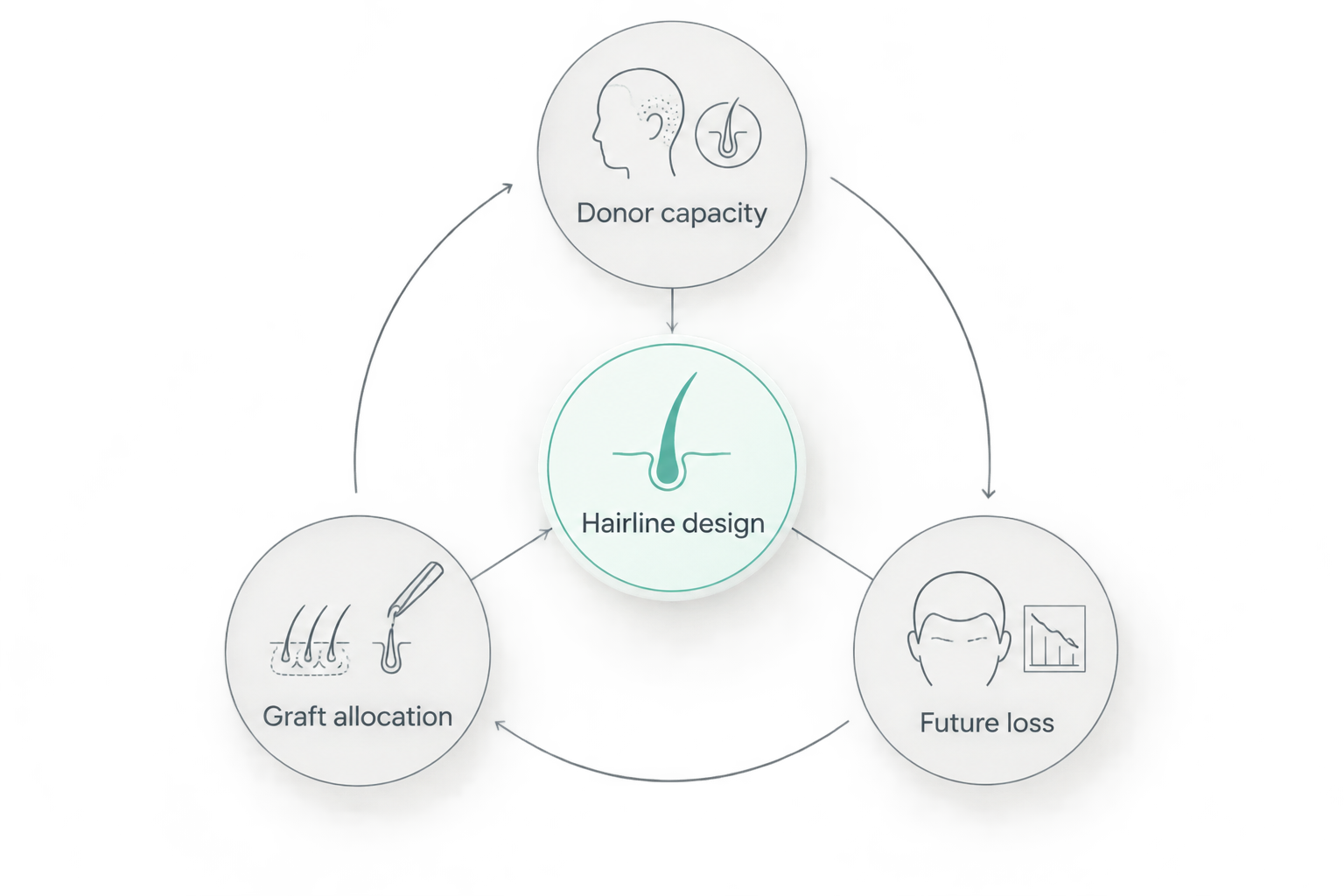
A useful consultation ends with an explanation of trade-offs, not just a graft total. Ask what the clinician would change if preserving donor hair became the main priority.
How to assess a natural-looking hairline
A natural-looking hairline depends on placement, direction, distribution, and how the design fits your face. Lower is not automatically more natural, and density alone does not determine whether the result looks convincing.
Ask to see the proposed outline from the front, sides, and above. Then discuss how the design would look if the hair behind it continued to thin.
For your 2026 assessment, bring photographs that show your previous hairline and explain what bothers you now. Use those images to communicate preferences, not to demand an exact reconstruction that your donor supply cannot support.
A good design discussion includes the option of doing less. A more conservative outline can preserve donor hair, although the right design still depends on examination and your priorities.
What patient photographs can—and cannot—prove
Before-and-after photographs document an individual patient’s appearance. They do not establish the outcome another patient should expect.
Look for consistent lighting, camera angles, hair length, and styling. Wet hair, different combing, concealing products, and changes in exposure can make comparisons difficult.
Ask whether the examples show patients with a similar pattern of loss, hair texture, and donor characteristics. Also ask when the postoperative photographs were taken and whether medication or additional procedures contributed to the appearance.
Use photographs to assess relevance and presentation, not to calculate your own guaranteed result. A clinic should explain differences between the pictured patient and you rather than present the image as a promise.
Healing and follow-up belong in the decision
Hair transplantation is surgery. Discuss risks such as bleeding, infection, scarring, altered sensation, and an unsatisfactory cosmetic result with the treating clinician.
FUE does not mean scar-free treatment. Small extraction scars can remain, and the visibility of scarring depends on individual factors and how the donor area is managed.
Before booking, request written guidance covering washing, activity, medications, scalp care, and warning signs. Your clinician should set individualized restrictions rather than leave you to follow a generic online recovery schedule.
For New York patients comparing clinics in 2026, clarify where follow-up happens and who handles concerns outside a scheduled appointment. Convenience matters most when you need an examination, not just when arranging the initial visit.
When an alternative deserves priority
Medical hair loss assessment — best for uncertain diagnosis or active thinning. Its advantage is that it addresses the cause and management of hair loss before surgery. Its limitation is that medical treatment does not transplant follicles into a new hairline.
Standard FUE assessment — best for comparing surgical plans beyond instrument choice. Its advantage is keeping the focus on extraction, design, and graft placement rather than a blade label. Its limitation is the same fundamental constraint as Sapphire FUE: surgery needs suitable donor hair and appropriate candidacy.
PRP assessment — best for discussing a possible adjunct. PRP uses a preparation from your own blood and is studied for hair loss, but treatment protocols and evidence vary. It does not supply new donor follicles or replace transplantation where surgical redistribution is the objective.
Do not assume that a newer-sounding treatment has stronger evidence. Ask about the exact treatment, its intended purpose, relevant research, risks, and regulatory status before agreeing to it.
How this shortlist is organized
This guide identifies a named Sapphire FUE consultation option and compares the clinical pathways that affect your decision. It does not assign outcome scores or claim that one clinic produces better growth than another.
The selection criteria are diagnosis, donor preservation, surgical responsibility, hairline planning, relevant evidence, and aftercare. A clinic earns your confidence by answering those questions clearly—not by occupying a numbered position.
Which clinic should you choose?
Choose the clinic whose clinician can explain why the proposed procedure fits your scalp and long-term priorities. If the explanation centers on blade material while leaving donor limits or surgical responsibilities unclear, pause.
For your 2026 decision, leave the consultation with a written outline of the proposed design, graft allocation, alternatives, risks, and follow-up arrangements. You do not need to commit during that appointment.
Peakhairtransplant is an option to assess, not a substitute for assessment. Proceed only when the clinical reasoning is clear and your expectations match the limitations discussed.
FAQ
What is the best Sapphire FUE hair transplant clinic in NYC?
The best clinic for you is one that confirms candidacy, explains donor limits, names the treating clinician, and provides a realistic surgical plan. A Sapphire FUE label alone does not establish clinical quality or predict your result.
Is Sapphire FUE better than standard FUE?
Sapphire blade use alone does not establish that a procedure will produce a better result than standard FUE. Compare the complete surgical plan, clinician responsibilities, donor management, and evidence behind any claimed advantage.
How many grafts do I need for a receding hairline?
Your graft requirement needs an individual clinical assessment. The area being treated, hair characteristics, donor capacity, and proposed hairline all affect the recommendation.
Can Sapphire FUE give me my original teenage hairline?
Recreating a teenage hairline is not automatically an appropriate surgical goal. A clinician must balance your preferences with donor limits, facial proportions, and the possibility of future thinning.
Does FUE leave scars?
FUE can leave small scars at extraction sites. Ask the clinician how extraction planning, healing, and your preferred hair length affect the likely visibility of those scars.
Should I try PRP instead of a hair transplant?
PRP and transplantation serve different purposes, so the choice starts with a diagnosis. PRP does not relocate follicles to build a new hairline; ask whether it has a relevant role in your treatment plan.
What should I bring to a New York hair transplant consultation?
Bring your medical and medication history, a timeline of hair loss, and photographs showing earlier hair patterns. Explain your styling preferences and priorities so the clinician can assess the trade-offs that matter to you.
One last thing
Ask the clinician: What would make you recommend against operating on me? The answer tests whether the consultation is an assessment rather than a predetermined route to surgery.
A clear explanation of when not to operate is as useful as a proposed hairline. Keep that answer beside the treatment plan when making your decision.