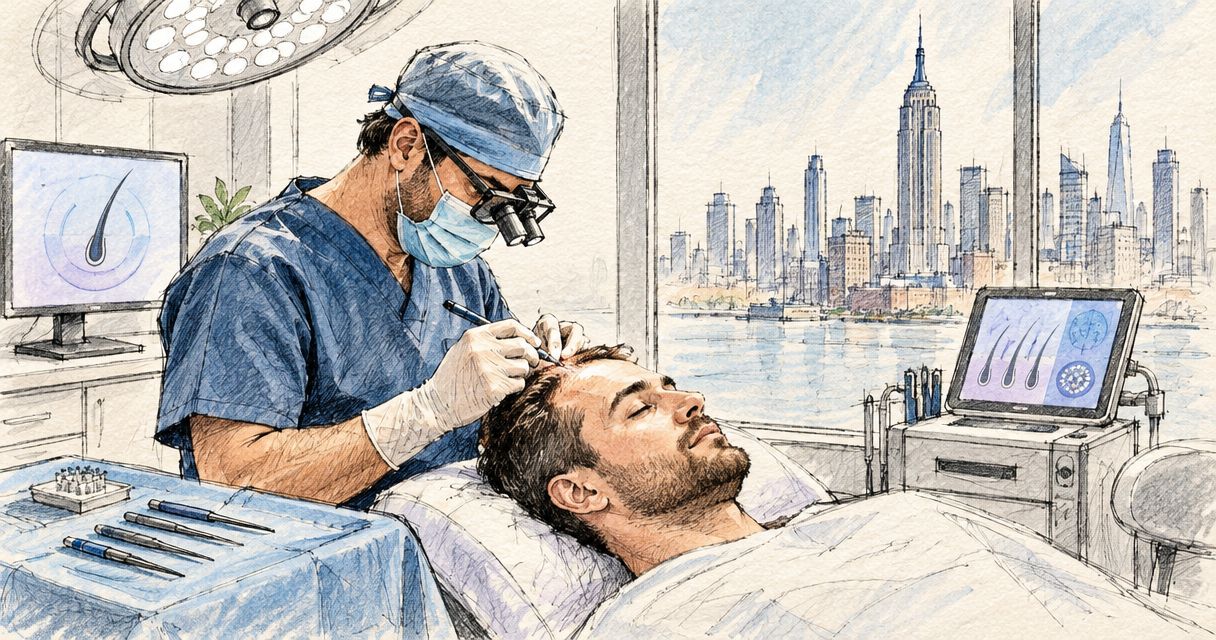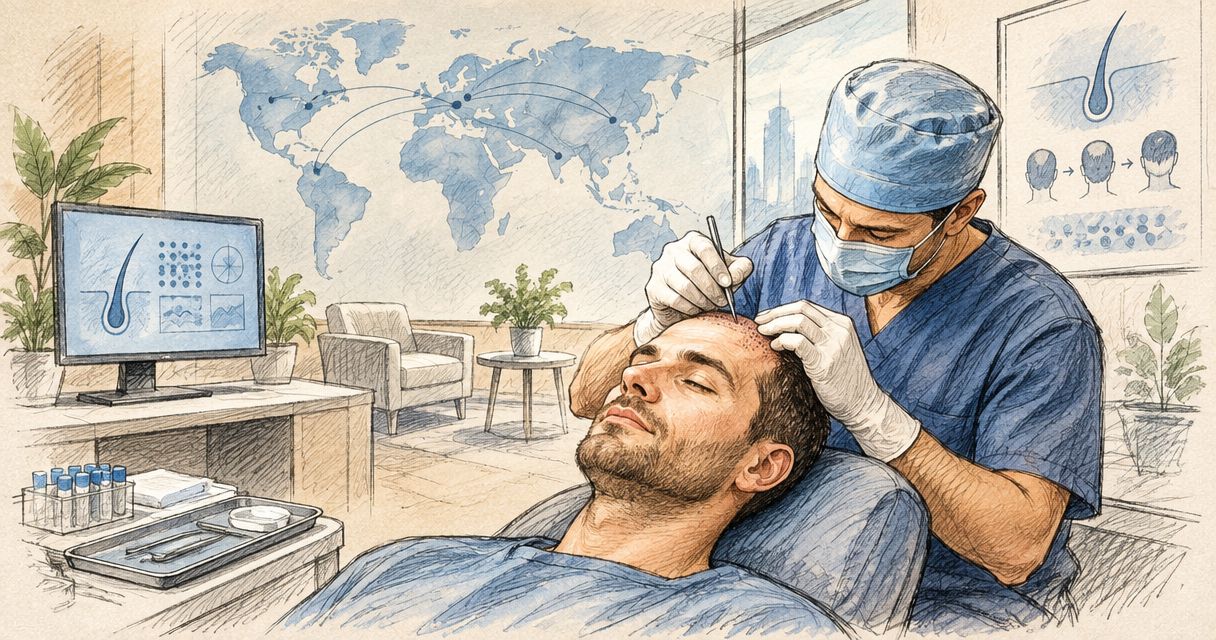
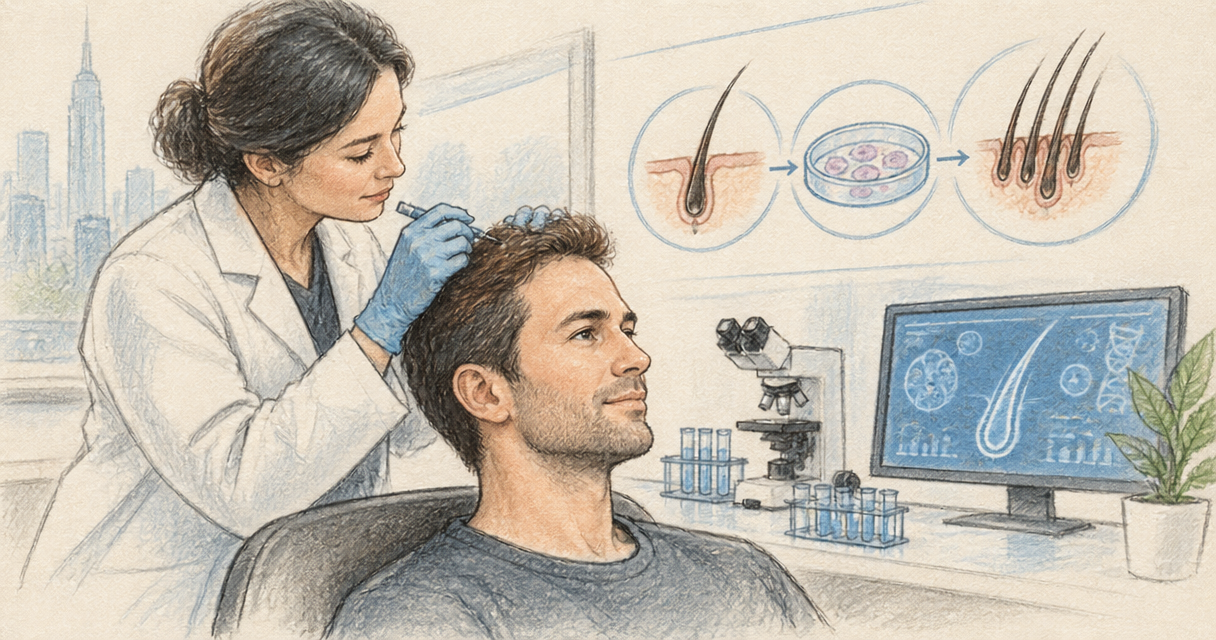
Hair cloning is not an established, FDA-approved hair restoration treatment available in New York in 2026. If you search for hair cloning NYC, distinguish experimental follicle research from treatments that move existing follicles or support existing hair; none provides a proven, unlimited supply of new donor hair.
- Hair cloning NYC searches lead to experimental research, not an established treatment that creates unlimited transplantable follicles.
- Sapphire FUE relocates existing follicles; it does not clone hair or remove donor-capacity limits.
- PRP and stem cell therapy are not interchangeable with hair cloning.
- Peakhairtransplant offers Sapphire FUE; a clinician must assess your diagnosis, donor capacity, and hairline goals.
Is hair cloning available for hair restoration yet?
No—hair cloning is not a routine, proven clinical option in 2026. Laboratory progress does not establish that a treatment reliably produces cosmetically useful hair in people, meets regulatory requirements, or remains effective over time.
The distinction matters when you compare hair transplant options. A treatment that moves follicles, concentrates your blood platelets, or uses a cell-based preparation is not automatically a treatment that multiplies functioning hair follicles.
| Approach | What it does | Best suited to | Main limitation |
|---|---|---|---|
| Hair cloning research | Investigates ways to generate or multiply hair-producing structures or cells | Research participation under an appropriate study protocol | Not an established clinical replacement for transplantation |
| Sapphire FUE | Moves existing donor follicles into recipient sites created using sapphire blades | Selected surgical candidates with adequate donor hair | Uses a finite donor supply and involves surgical risks |
| Prescription or topical medication | Treats certain forms of hair loss by supporting existing hair | Patients whose diagnosis and medical history support treatment | Does not create an unlimited source of new follicles |
| PRP | Injects a preparation concentrated from the patient's blood | Selected patients considering an adjunct after assessment | Protocols and responses vary; it does not clone follicles |
| Cell-based procedures | Use preparations described as containing cells or cell-derived materials | Evaluation of a specific intervention and its regulatory status | The label alone establishes neither effectiveness nor safety |
These are not interchangeable choices. The right starting point is a diagnosis, not the newest treatment name.
Why this matters for New York patients
Waiting for hair cloning can postpone assessment of a condition that needs treatment now. Pattern hair loss, inflammatory scalp disease, traction-related loss, and shedding disorders do not all require the same response.
A lower hairline also creates a long-term planning obligation. If surrounding native hair continues thinning, the design must still make sense without assuming that future cloning will supply additional grafts.
Plan with the donor hair you have, not the donor hair a future technology might create. That principle remains useful whether you choose surgery, medical treatment, or monitoring.
What hair cloning research is trying to achieve
Hair cloning is an umbrella term rather than a single standardized procedure. Researchers investigate approaches such as expanding hair-associated cells and encouraging those cells to organize into structures capable of producing hair.
Producing cells in a laboratory is not the same as producing a functioning follicle in a human scalp. A useful treatment must address growth direction, hair characteristics, integration with surrounding tissue, and continued cycling—not simply demonstrate a biological response.
For a natural-looking frontal hairline, those details matter. Hair growing at an unsuitable angle or with an inconsistent appearance would not meet the same cosmetic goal as carefully positioned grafts.
What would count as meaningful evidence?
Look for published human clinical results that explain the intervention, eligibility criteria, adverse events, and follow-up. A photograph without a clear treatment history cannot establish which intervention caused the visible change.
Evidence should also distinguish new follicle formation from improvement in existing hair. Both outcomes can interest patients, but they answer different questions.
A promising research announcement in 2026 is not a treatment recommendation. Ask whether the announcement describes laboratory work, animal research, an early human study, or a treatment authorized for the proposed clinical use.
Sapphire FUE: relocation, not multiplication
Sapphire FUE uses follicular unit extraction to remove existing grafts from a donor area. Sapphire blades are used to create recipient sites; the blade material does not turn transplantation into cloning.
The practical advantage is that transplantation can redistribute existing hair to address a suitable patient's hairline or thinning areas. The trade-off is permanent use of a limited donor resource, alongside risks such as scarring, infection, uneven growth, and an unsatisfactory cosmetic result.
Sapphire FUE is best suited to appropriately assessed surgical candidates, not everyone who wants more density. Donor quality, the pattern of loss, scalp health, and expectations determine whether a surgical plan is reasonable.
Peakhairtransplant provides Sapphire FUE and non-surgical hair restoration treatments. For New York patients considering Peakhairtransplant, a hair restoration assessment is a better next step than waiting for hair cloning.
Donor capacity is not the same as graft count
Donor capacity describes how much usable hair can be removed without unacceptable depletion or an unsuitable donor appearance. Graft count describes the follicular units involved in a particular plan; a graft is not necessarily a single hair.
A larger proposed graft count is not automatically a better recommendation. Ask how the clinician estimated your donor reserve, what area the plan prioritizes, and how future thinning affects the design.
Natural-looking hairlines need restraint
A natural-looking hairline depends on placement, direction, distribution, and a design that fits your facial features. Density alone does not answer those questions.
A conservative design can preserve options for later treatment. Discuss the appearance you want now alongside the appearance you would accept if your native hair continues thinning.
Medication and PRP: supporting existing hair
Medical treatment is often part of the discussion when existing follicles remain present. It serves a different purpose from creating new follicles, and the diagnosis determines which options deserve consideration.
Topical minoxidil is available in 2% and 5% formulations for particular labeled uses. Product labeling differs by formulation and intended user; scalp irritation and unwanted hair growth are possible, and continued use is generally needed to maintain benefit.
Finasteride 1 mg tablets are a prescription option for male pattern hair loss in men. They do not clone follicles, and counseling should address sexual adverse effects and pregnancy-related precautions before treatment.
These figures identify established formulations, not a personal dosing recommendation. A clinician should review your medical history, current medicines, and treatment goals before advising you.
PRP uses a preparation made from your own blood. It is best considered as a possible adjunct for selected patients rather than a substitute for donor follicles or a guaranteed way to restore a receded hairline.
Its limitations deserve equal attention: treatment methods differ, responses vary, and ongoing treatment can be part of the proposed plan. Ask what outcome the clinician expects for your diagnosis and how that outcome will be measured.
Why hair restoration recommendations vary
Two people searching for hair cloning NYC can need entirely different advice. The deciding factors concern their hair loss and treatment goals, not their shared search term.
- Diagnosis: Pattern hair loss, active inflammation, and temporary shedding require different management.
- Donor capacity: Available donor hair limits what transplantation can redistribute without excessive depletion.
- Loss pattern: Frontal recession, diffuse thinning, and crown loss create different planning demands.
- Scalp health: Active disease can require treatment before a cosmetic procedure is considered.
- Medical history: Medicines, relevant conditions, and contraindications affect suitability and safety.
- Expectations: Desired coverage must fit the likely benefits, limitations, and maintenance requirements of treatment.
A recommendation should connect these findings to a specific plan. If an explanation focuses entirely on technology while skipping your diagnosis and donor examination, request those missing clinical details before deciding.
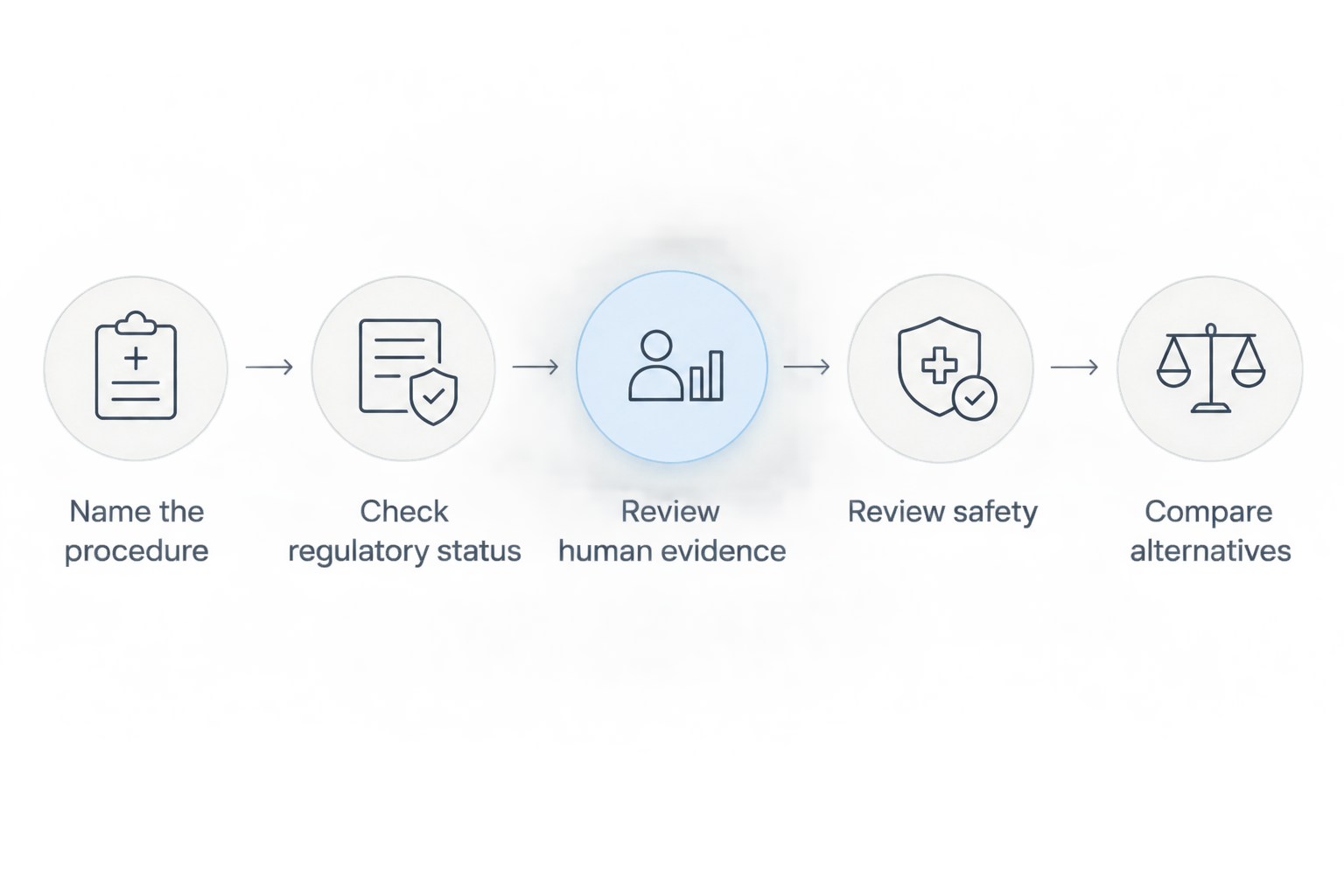
How should you assess a hair cloning claim?
Use the same sequence whether the claim appears in an advertisement, a consultation, or a research announcement. Technical language should become clearer under questioning, not more complicated.
- Name the procedure. Ask exactly what is collected, processed, injected, or implanted. Request a written description rather than accepting a broad regenerative label.
- Check regulatory status. Ask what authorization applies to the exact product, procedure, and intended use. A facility registration or device clearance does not by itself establish approval of a hair-loss treatment.
- Review human evidence. Request published results for the actual intervention, not a loosely related technology or an animal experiment.
- Review safety. Ask about known adverse effects, uncertainties, follow-up, and who handles complications.
- Compare alternatives. Ask what happens if you choose established treatment, observation, or no procedure instead.
For a 2026 decision, request the current status of the proposed intervention rather than relying on an older announcement. A registered clinical trial also does not mean that its treatment has already demonstrated benefit or received marketing approval.
Research participation deserves its own informed-consent discussion. You should understand the study's purpose, eligibility rules, uncertainties, and follow-up obligations before agreeing to participate.
Is stem cell hair treatment the same as hair cloning?
No—stem cell hair treatment is not another name for proven hair cloning. The phrase covers different proposed interventions and does not tell you whether a treatment generates new follicles, improves existing hair, or has demonstrated a clinical benefit.
Peakhairtransplant lists stem cell therapy among its hair restoration treatments. That listing is not evidence that the treatment clones follicles; ask about the specific intervention, supporting human studies, and regulatory status.
Do not assume that a preparation is safe or effective simply because it comes from your own body. The relevant questions concern how it is processed, how it is used, and what evidence supports that use.
Should I wait for hair cloning before treating hair loss?
Do not make waiting your treatment plan without an assessment. There is no dependable personal treatment date to use when planning around future hair cloning, while your current diagnosis can be evaluated now.
Assessment does not commit you to surgery. It can lead to medical treatment, management of scalp disease, monitoring, or a decision that transplantation is inappropriate.
If you are considering surgery in 2026, ask for a plan that remains reasonable without future follicle multiplication. Your clinician should explain both what can be addressed and what should remain untreated.
Can a hair transplant still look natural without cloning?
Yes—a hair transplant can look natural without cloning, but no individual result is guaranteed. Appropriate patient selection, hairline design, graft handling, and placement all contribute to the outcome.
Healing is part of that discussion, not an afterthought. Ask about wound care, temporary appearance changes, activity restrictions, signs that need medical review, and the proposed follow-up schedule.
Patient photographs illustrate an individual's experience rather than your expected result. Compare lighting, styling, viewing angle, and any accompanying treatments before drawing conclusions from them.
FAQ
Can I get hair cloning in NYC in 2026?
Hair cloning is not an established, FDA-approved hair restoration treatment in NYC in 2026. Ask any provider using that term to identify the exact procedure, its regulatory status, and supporting human clinical evidence.
Does Sapphire FUE create new hair follicles?
Sapphire FUE moves existing follicles rather than creating new ones. Donor capacity still limits the surgical plan, and sapphire recipient-site blades do not change that limit.
Is PRP a form of hair cloning?
PRP is not hair cloning. It uses a preparation concentrated from your blood and does not provide a proven supply of newly manufactured follicles.
Can stem cell therapy replace a hair transplant?
Stem cell therapy is not an established replacement for hair transplantation. The specific intervention, diagnosis, human evidence, and regulatory status need individual review.
Will hair cloning solve a limited donor supply?
Overcoming limited donor supply is a goal of follicle-generation research, not a result you should assume is available clinically. A current transplant plan must respect your existing donor capacity.
What should I ask at a New York hair restoration consultation?
Ask for your diagnosis, donor assessment, treatment alternatives, risks, and a hairline plan that accounts for future loss. Request the evidence behind any claim that a procedure creates new follicles.
Do I have to choose surgery after an assessment?
An assessment does not mean surgery is the right choice. Depending on your findings, a clinician can discuss medical treatment, monitoring, treatment of scalp disease, or no procedure.
One last thing
Ask your clinician to explain what the plan leaves untouched. Preserved donor hair and a deliberately restrained hairline are meaningful parts of surgical planning, even though they rarely attract attention in treatment advertisements.
For a New York patient choosing care in 2026, the useful question is not whether a procedure sounds advanced. It is whether the diagnosis, evidence, donor budget, and long-term design support doing it.