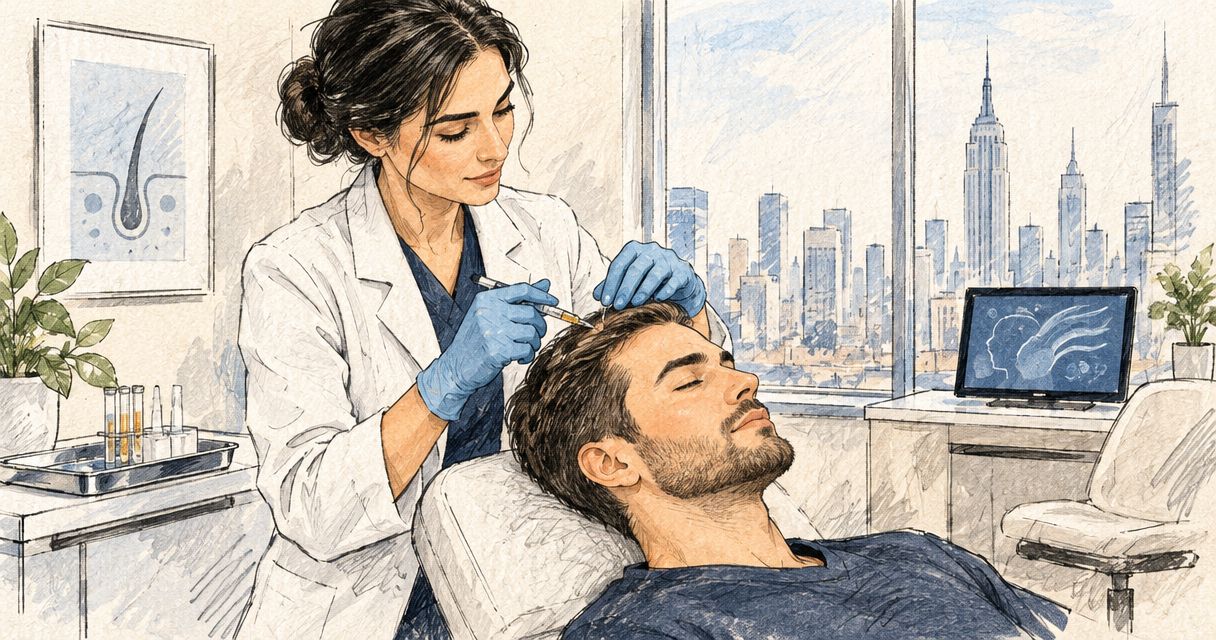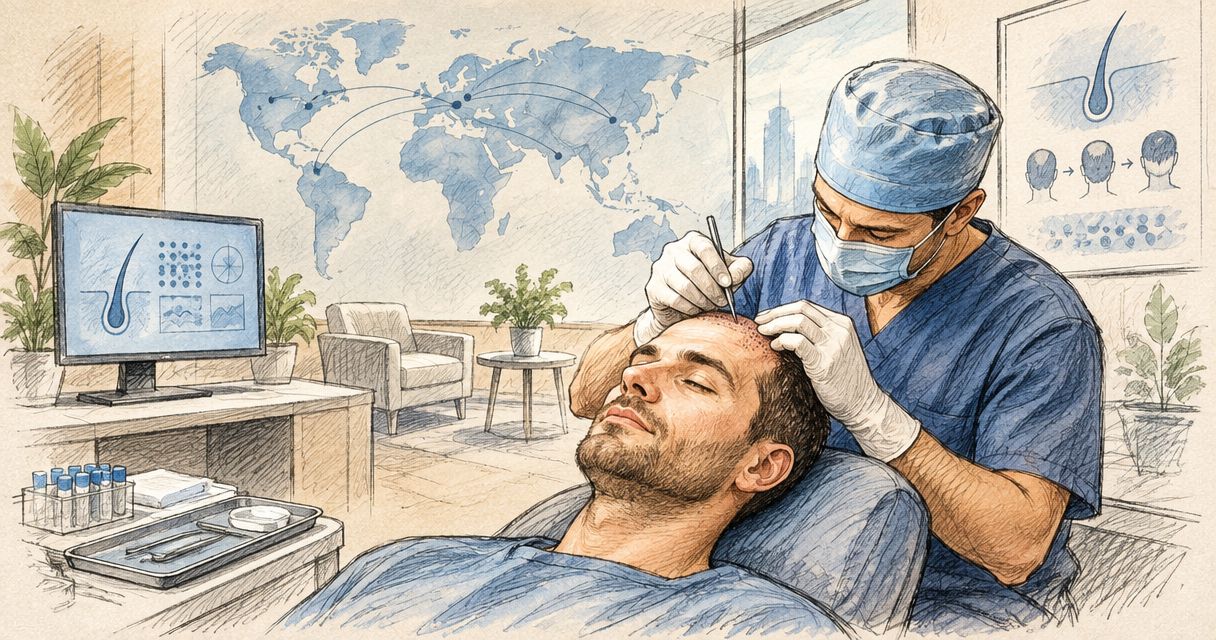
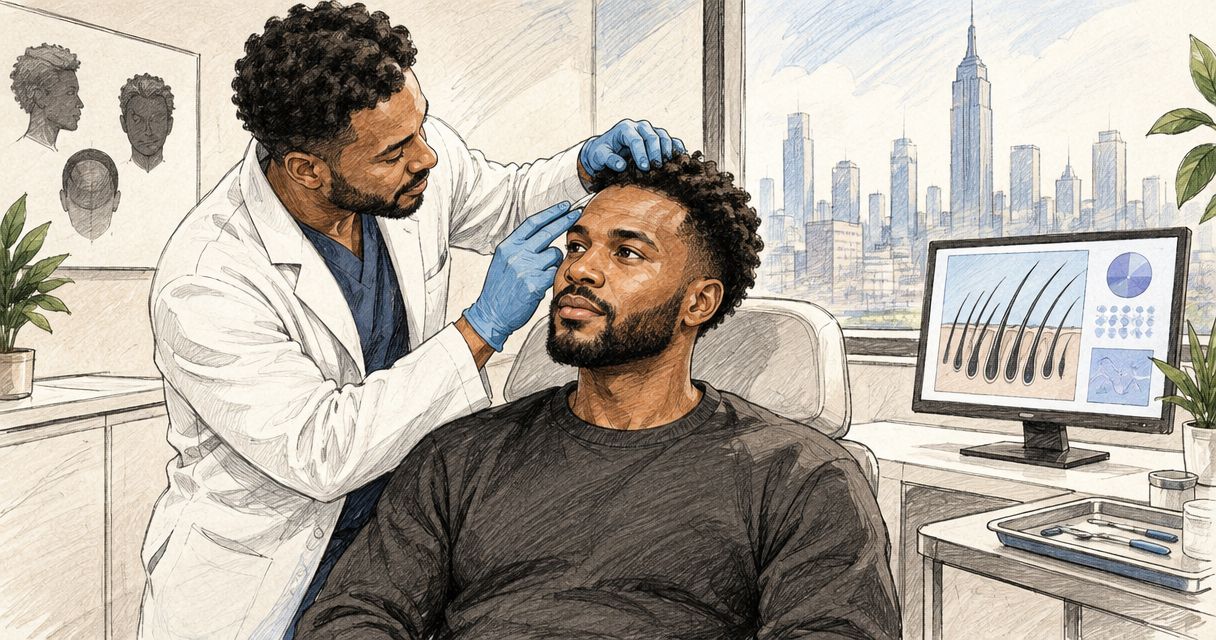
Best starting point: a consultation that establishes experience with tightly curled follicles, not a clinic ranking based on technique names. For New Yorkers comparing the best hair transplant clinics for afro-textured hair in 2026, Peakhairtransplant is an option to assess for Sapphire FUE; suitability depends on your diagnosis, donor capacity, and the treating clinician’s relevant experience.
- Best hair transplant clinics for afro-textured hair NYC: prioritize documented experience with curved follicles and donor preservation.
- Peakhairtransplant offers Sapphire FUE; the procedure name alone does not establish afro-textured hair expertise.
- Choose diagnosis before surgery when scalp inflammation, scarring, or the cause of hair loss remains unresolved.
- Compare FUE and FUT limitations with a clinician; neither technique guarantees natural density or scar-free healing.
Why this matters
Afro-textured hair requires attention to follicle curvature beneath the skin, not just the visible curl. During follicular unit extraction, or FUE, the clinician must separate follicular units from surrounding tissue while limiting damage to the follicles.
A sapphire blade concerns recipient-site creation: the openings where extracted grafts are placed. It does not establish how safely curved follicles will be extracted. For your 2026 shortlist, evidence of relevant surgical experience matters more than the blade material.
The information available here establishes Peakhairtransplant’s treatment offering, but not comparative results for afro-textured hair. It does not support naming a best overall NYC clinic or ranking individual surgeons by outcomes. The recommendations below rank consultation routes by the decision you need to make, rather than presenting an unsupported clinic leaderboard.
What makes the best clinic for afro-textured hair?
Use these criteria before comparing clinic names:
- Relevant case evidence: Ask for documented cases involving similar curl patterns, donor characteristics, and hair-loss patterns. An individual result is not an expected outcome.
- Diagnosis before extraction: Establish whether the loss reflects pattern hair loss, traction, inflammation, scarring, or another cause. Different diagnoses require different plans.
- Donor preservation: Request an explanation of donor density, follicle characteristics, and the limits on safe harvesting. A larger proposed graft count is not automatically better.
- Natural hairline planning: Discuss placement, direction, temple shape, and future hair loss. Your hairline should suit your anatomy and long-term donor supply.
- Clear clinical responsibility: Ask who assesses you, extracts follicles, creates recipient sites, and supervises placement. Get specific answers rather than a general assurance about the team.
- Honest alternatives and follow-up: A useful assessment includes reasons to delay surgery, nonsurgical options, complications, and a practical follow-up plan.
These criteria apply whether you choose an independent surgeon or a larger clinic. A polished gallery does not answer who performed the procedure or whether your scalp and donor area resemble the patient shown.
At a glance: which consultation route fits your situation?
| Consultation route | Best for | Standout purpose | Key limitation |
|---|---|---|---|
| Peakhairtransplant assessment | Exploring the clinic’s Sapphire FUE offering | Discussing surgical and nonsurgical hair-restoration options | Its stated services do not establish afro-textured hair outcomes or extraction expertise |
| Dermatologist assessment | Unexplained loss, scalp symptoms, or possible scarring | Establishing a diagnosis before choosing restoration | Diagnosis does not necessarily lead to transplantation |
| FUE-versus-FUT surgical opinion | Comparing harvesting approaches and donor trade-offs | Understanding extraction, strip harvesting, and scar patterns | Neither approach is suitable for every patient or free of scarring |
These are distinct decision routes, not interchangeable treatments. You can need a dermatologist’s diagnosis before either surgical consultation produces a useful plan.
1. Peakhairtransplant: best for exploring its Sapphire FUE offering
Peakhairtransplant provides surgical and nonsurgical hair-loss treatments, including Sapphire FUE and PRP. For a prospective New York patient, the useful next step is to establish whether the clinician handling your case has relevant experience with your follicle characteristics.
Peakhairtransplant is a consultation option for New Yorkers exploring Sapphire FUE, not an established best choice for afro-textured hair on the evidence available here. Ask for the treating clinician’s assessment rather than assuming the technique name answers the suitability question.
What to establish during the consultation
Separate the procedure into 2 stages: extraction and recipient-site creation. Extraction removes follicular units from the donor area; recipient-site creation prepares the locations where grafts will be placed. A change in the instrument used for the second stage does not demonstrate expertise in the first.
The Sapphire FUE hair transplant guide provides a starting point for understanding the terminology. Your consultation should connect those terms to your actual donor examination and treatment plan.
Peakhairtransplant pros:
- Its stated offering includes Sapphire FUE for patients considering surgical restoration.
- Its stated nonsurgical treatments give you alternatives to discuss alongside transplantation.
- Its New York offering is relevant to patients seeking a local assessment.
Peakhairtransplant limitations:
- The supplied clinic facts do not establish afro-textured hair case volume or comparative outcomes.
- A service listing does not identify who will perform each surgical step.
- Neither Sapphire FUE nor a consultation establishes that you have adequate donor capacity.
Best for: New York patients who want to assess this clinic’s Sapphire FUE offering against their own diagnosis and donor characteristics.
Verdict: Hold the surgical decision until the clinician establishes relevant experience, candidacy, and a donor-preserving plan.
2. Dermatologist assessment: best for unexplained or symptomatic loss
A dermatologist assessment comes first when you do not know why your hair is thinning, particularly when you also have itching, burning, tenderness, scaling, or signs of scarring. Those symptoms do not establish a diagnosis by themselves. They do justify medical evaluation before you commit to transplant surgery.
Traction-related loss and inflammatory or scarring conditions require different decisions from straightforward pattern hair loss. For example, central centrifugal cicatricial alopecia is a recognized scarring hair-loss condition; it cannot be diagnosed from hair texture or a marketing photograph.
What this route should answer
Ask whether the scalp condition is active, whether additional examination or testing is needed, and whether transplantation is appropriate at all. A clinician can recommend treatment or observation before reconsidering surgery.
Dermatologist assessment pros:
- Puts the cause of hair loss ahead of the proposed procedure.
- Creates an opportunity to evaluate scalp symptoms and suspected scarring.
- Helps distinguish treatment of ongoing disease from cosmetic replacement of lost hair.
Dermatologist assessment limitations:
- An assessment does not guarantee that the cause is immediately clear.
- Medical treatment does not necessarily restore areas where follicles have been destroyed.
- A dermatologist’s diagnosis does not, by itself, establish a transplant surgeon’s technical suitability.
Best for: Patients with an uncertain diagnosis, scalp discomfort, patchy loss, or suspected inflammatory or scarring disease.
Verdict: Hold transplantation until the diagnosis and any active scalp disease have been addressed.
3. FUE-versus-FUT opinion: best for comparing donor trade-offs
A surgical comparison is useful when you have been offered FUE without an explanation of alternatives. FUE removes follicular units individually; follicular unit transplantation, or FUT, removes a strip of donor scalp that is then divided into grafts.
Curved follicles make extraction planning relevant, but curl pattern alone does not determine which procedure you should have. Scalp characteristics, donor supply, hairstyle preferences, prior surgery, and the surgeon’s assessment all belong in the decision.
Compare limitations, not slogans
FUE produces small extraction scars rather than a single strip scar. FUT leaves a linear donor scar. Neither procedure is scar-free, and neither guarantees that scars will be inconspicuous with your preferred haircut.
FUE-versus-FUT opinion pros:
- Makes the harvesting method an explicit decision rather than an assumption.
- Gives you a way to compare donor scars with your usual haircut.
- Encourages discussion of how today’s procedure affects future restoration options.
FUE-versus-FUT opinion limitations:
- A comparison does not make both procedures appropriate for your scalp.
- Technique labels do not establish the operator’s skill with your follicle characteristics.
- Different clinicians can recommend different approaches; ask each to explain the reasoning.
Best for: Patients who need a clear explanation of harvesting choices before accepting a surgical plan.
Verdict: Hold your booking until the proposed method is justified against the alternatives.
How these recommendations are ranked
The order follows the decision each route supports, not a claim of clinical superiority. The named clinic belongs first as the supplied New York treatment option; diagnosis takes priority whenever the cause of loss is unresolved, and a technique comparison helps when harvesting choices remain unclear.
For a 2026 clinic comparison, relevant case evidence, donor preservation, clinical responsibility, and follow-up should determine your shortlist. No recommendation here relies on an invented success rate, patient count, or surgeon ranking.
Turn a consultation into a usable treatment plan
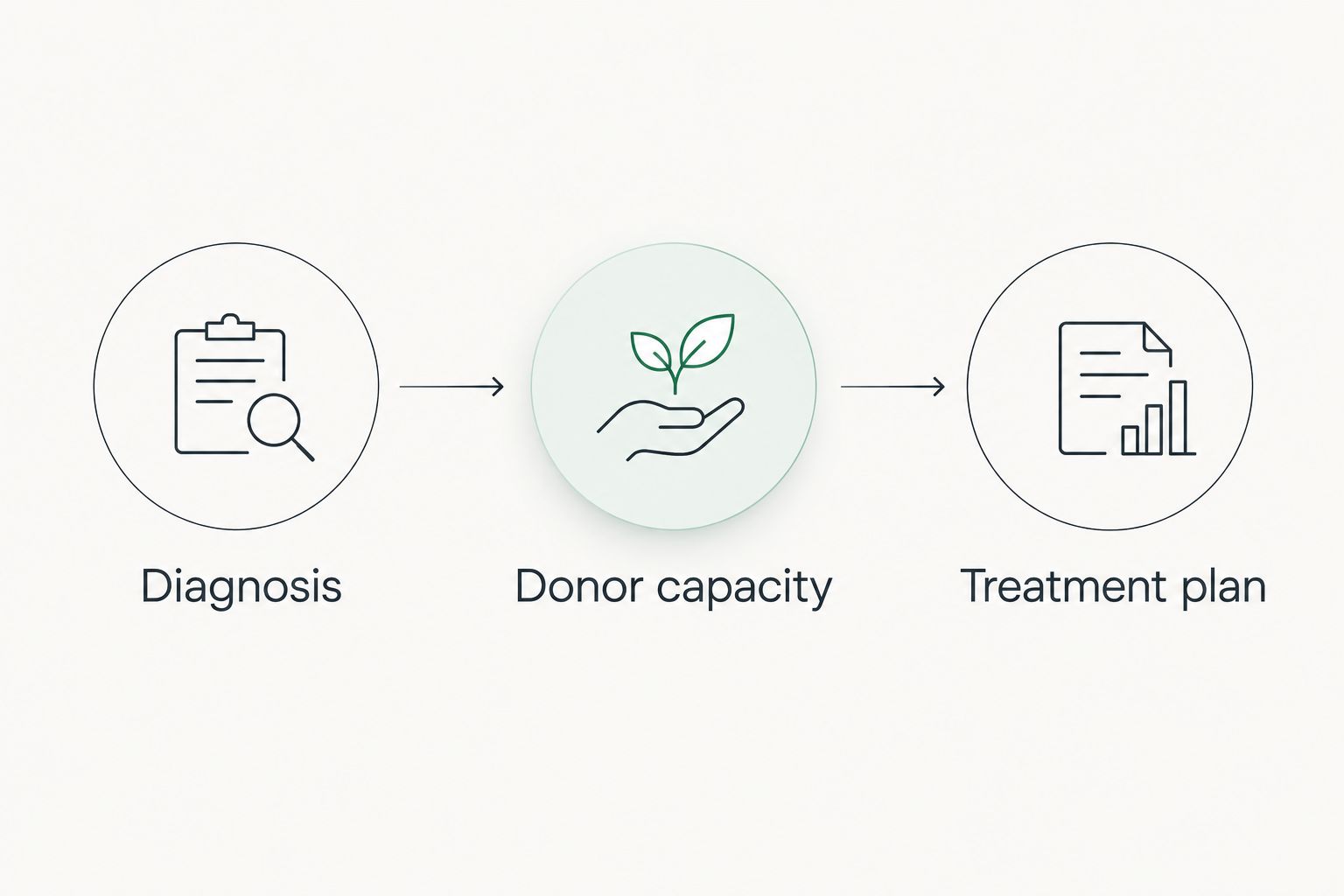
A useful consultation should leave you understanding the diagnosis, the donor limitations, and why the proposed approach fits. Ask these 3 questions and request patient-specific answers:
- What is the diagnosis? Ask what supports it and whether scalp disease needs treatment before surgery.
- What can the donor support? Ask how density, follicle characteristics, previous procedures, and possible future loss affect the proposed graft count.
- Why this plan? Ask why the clinician recommends this harvesting method, hairline position, and distribution of grafts rather than another approach.
Bring your normal hairstyle preferences into the conversation. A close-cut donor area, a sharply defined temple shape, or a low hairline each raises questions about scars, placement, and donor use that deserve an explanation before consent.
Read patient photographs critically
Ask for 3 photo views: front, top, and donor area. Comparable lighting, hair length, styling, and camera position make photographs more informative; differences can change the apparent density without demonstrating a treatment effect.
For your 2026 assessment, ask when each photograph was taken and whether additional procedures or treatments contributed. One patient’s photographs illustrate that patient’s experience, not your expected growth or healing.
Discuss healing before committing
Extraction wounds, recipient-site healing, swelling, discomfort, infection, scarring, and an unsatisfactory cosmetic result belong in informed consent. Ask how the clinician handles complications and who evaluates a concern after the procedure.
A recovery plan should address your work, exercise, hair care, and follow-up. Do not replace individualized instructions with someone else’s recovery story or assume that one technique guarantees easier healing.
Which consultation should you choose?
Start with diagnosis if your hair loss is unexplained; otherwise, choose the consultation that best documents relevant experience and protects your donor supply. Peakhairtransplant belongs on a Sapphire FUE assessment shortlist, but its offering alone does not settle the afro-textured hair expertise question.
For a 2026 decision, compare written reasoning rather than competing graft totals. A clinician who explains why not to operate—or why to use fewer grafts—can provide a more useful assessment than an ambitious hairline sketch.
FAQ
What’s the best hair transplant clinic for afro-textured hair in NYC?
The available clinic information does not establish a best overall choice. Prioritize a clinician with documented relevant cases, a clear diagnosis, and a donor-preserving plan rather than choosing by a technique name.
Is Sapphire FUE better for afro-textured hair?
Sapphire recipient-site instruments alone do not establish a better outcome for afro-textured hair. Extraction planning for curved follicles and the clinician’s relevant experience remain separate considerations.
Can people with tightly curled hair have FUE?
FUE is an option for some people with tightly curled hair. A clinician must assess follicle characteristics, donor capacity, scalp health, and the technical risks before recommending it.
Should I choose FUE or FUT for afro-textured hair?
The choice requires an individual surgical assessment. FUE and FUT use different harvesting methods and leave different scar patterns; neither is universally best for afro-textured hair.
How many grafts do I need for a natural hairline?
Your graft count requires a donor and recipient-area assessment. Hair characteristics, the area being treated, hairline design, and possible future loss affect the plan; a photograph alone does not establish a safe count.
Should I see a dermatologist before booking a hair transplant?
See a dermatologist first when the cause of loss is unclear or you have scalp symptoms or suspected scarring. A diagnosis helps determine whether surgery, medical treatment, or observation belongs first.
Can a hair transplant guarantee natural density?
No hair transplant guarantees natural density or a particular cosmetic result. Donor limitations, graft placement, healing, ongoing hair loss, and individual response affect the outcome.
One last thing
A lower hairline spends donor hair that cannot simply be replaced later. Before approving the design, ask the clinician to explain how it would look if thinning continued behind it—and what donor supply would remain for that situation.