

For hair transplant cost NYC comparisons in 2026, rank comparable written treatment plans—not clinics by headline offers. Peakhairtransplant is an option for New York patients seeking a Sapphire FUE assessment, not a verified lowest-cost recommendation.
- Hair transplant cost NYC comparisons should start with donor capacity, graft count, and a written treatment plan.
- Peakhairtransplant offers Sapphire FUE; candidacy and natural-looking hairline planning require an individual clinical assessment.
- Compare equivalent surgical plans before judging value; larger graft counts are not automatically better.
- PRP and other nonsurgical treatments are not interchangeable with transplant surgery.
Why this matters
A clinic-by-clinic cost ranking is useful only when the quotes describe comparable care. Different recipient areas, graft estimates, surgical responsibilities, and follow-up arrangements make headline comparisons misleading.
For your 2026 shortlist, ask each clinic to explain the clinical problem before discussing the financial commitment. A conservative hairline plan and a larger coverage plan are different proposals, even when both use the same procedure name.
The best-value plan is one that matches your diagnosis, protects your donor area, and explains its limitations. A clinician must determine whether surgery is appropriate; a quote cannot establish candidacy.
What makes a useful NYC hair transplant comparison?
Use these criteria before deciding which clinic belongs at the top of your shortlist:
- Diagnosis first: The clinician identifies the likely cause and pattern of hair loss before recommending treatment.
- Donor capacity: The plan explains what the donor area can reasonably contribute without treating every visible hair as expendable.
- Graft rationale: The proposed graft count follows from the recipient area, hair characteristics, and intended coverage.
- Natural hairline design: Placement accounts for facial proportions, existing hair, and possible future loss.
- Clinical responsibilities: You know who evaluates you, designs the hairline, and performs each surgical stage.
- Written aftercare: The proposal explains healing instructions, follow-up, and how to report concerns.
These criteria apply whether you are comparing Sapphire FUE with another extraction approach or considering whether to postpone surgery. None establishes that one clinic is universally best.
NYC hair transplant comparisons at a glance
The ranking below orders assessment priorities, not clinics by unverified charges. Use it to evaluate written proposals in 2026 without confusing a larger procedure with a better recommendation.
| Priority | Best for | What to compare | Main benefit | Key limitation |
|---|---|---|---|---|
| Diagnosis and candidacy | Unexplained or changing hair loss | Diagnosis, scalp findings, treatment alternatives | Establishes whether surgery fits | Does not determine the final surgical plan alone |
| Donor preservation | Advanced loss or previous surgery | Donor examination, extraction plan, future needs | Keeps long-term options central | Can limit achievable coverage |
| Hairline and graft plan | Receding hairlines | Design, recipient area, graft rationale | Connects the procedure to your appearance goals | Cannot guarantee density or growth |
| Surgical responsibilities | Comparing similarly named procedures | Named clinician and task allocation | Clarifies who delivers the care | A technique label does not establish skill |
| Aftercare and scope | Comparing written proposals | Included care, follow-up, concern reporting | Makes practical differences visible | Written arrangements do not predict healing |
1. Diagnosis and candidacy: best for unexplained hair loss
A transplant relocates hair follicles; it does not diagnose why your hair is thinning. Your assessment should address the pattern of loss, scalp condition, medical history, and whether the donor area is suitable.
Best for: Patients with recent changes, diffuse thinning, scalp symptoms, or uncertainty about the cause of their hair loss.
A surgical recommendation should explain why transplantation fits your particular situation. If the diagnosis needs further investigation, that comes before selecting a graft count.
Diagnosis-first assessment pros:
- Connects treatment to the underlying clinical problem.
- Gives nonsurgical management a place in the discussion.
- Helps you distinguish a surgical goal from a medical treatment goal.
Diagnosis-first assessment limitations:
- Further evaluation can delay a surgical decision.
- An appropriate assessment can conclude that transplantation is unsuitable.
Ask each clinic: What is the working diagnosis, what findings support it, and what would change the recommendation? You should understand the answer without needing to interpret technical terminology.
Verdict: Prioritize diagnosis before comparing surgical proposals.
2. Donor preservation: best for extensive loss or repeat surgery
Donor capacity is the usable supply of hair available for transplantation. It depends on the donor area's condition and hair characteristics—not simply the size of the thinning area you want covered.
Best for: Patients with extensive thinning, previous transplantation, or concern about future hair loss.
A responsible plan connects extraction to long-term needs. Ask which areas receive priority if your available donor supply cannot support every coverage goal.
Donor-focused planning pros:
- Makes the limits of transplantation explicit.
- Helps balance frontal restoration against crown coverage.
- Keeps possible future treatment needs in the discussion.
Donor-focused planning limitations:
- Preserving donor hair can mean accepting less coverage now.
- Previous extraction or donor thinning can restrict your choices.
Do not treat a higher proposed graft count as proof of better value. If one clinic recommends substantially more grafts, ask what examination findings justify the difference and how the plan protects the remaining donor area.
Verdict: Prioritize donor preservation over the largest graft proposal.
3. Hairline and graft planning: best for a receding hairline
A natural-looking hairline requires more than filling an empty strip of scalp. Position, shape, hair direction, and the transition into existing hair all belong in the clinical discussion.
Best for: Patients whose main concern is the frontal hairline or temples rather than broad scalp coverage.
Ask to review 2 hairline designs: your preferred outline and a more conservative alternative. This is a decision exercise, not a requirement to accept either design; it helps expose differences in coverage goals and donor demands.
Hairline-focused planning pros:
- Makes your appearance goals specific enough to discuss.
- Connects the proposed graft count to an actual recipient area.
- Creates space to consider how the design would look with further loss.
Hairline-focused planning limitations:
- A lower hairline can require more donor resources.
- A drawing or simulation cannot guarantee the healed result.
Peakhairtransplant offers Sapphire FUE, but the procedure name alone does not establish the right hairline or graft count for you. Review the natural hairline design guide, then ask the assessing clinician to explain the proposed design's trade-offs.
Verdict: Prioritize a defensible hairline design over a promise of maximum density.
4. Surgical responsibilities: best for comparing FUE proposals
FUE describes the extraction of individual follicular units. Sapphire FUE refers to the use of sapphire blades for recipient-site creation within an FUE procedure; the label does not describe every part of the operation.
Best for: Patients comparing proposals that use similar technique names but provide different explanations of care.
For your 2026 assessment, ask who performs the examination, designs the hairline, extracts follicles, creates recipient sites, and places grafts. Request names and roles rather than relying on a general statement that a medical team handles the procedure.
Responsibility-focused comparison pros:
- Separates the technique label from the people performing treatment.
- Makes surgical task allocation easier to compare.
- Gives you specific questions for the clinician responsible for your care.
Responsibility-focused comparison limitations:
- A written role description does not prove surgical skill.
- A named technique does not guarantee growth, density, or recovery.
For a Peakhairtransplant Sapphire FUE assessment, ask the same questions you would ask any other clinic. Consistent questions make the comparison fair and keep the discussion centered on your treatment rather than terminology.
Verdict: Prioritize clear clinical responsibility over technique branding.
5. Aftercare and written scope: best for comparing final proposals
A surgical proposal should explain what happens after you leave the clinic. You need instructions for scalp care, activity restrictions, follow-up, and reporting symptoms that concern you.
Best for: Patients who have completed clinical assessments and need to compare the practical scope of each proposal.
Request 1 written plan from each shortlisted clinic. Keep the treatment scope and financial terms together so you can identify differences without relying on memory.
Written-scope comparison pros:
- Makes included care and additional arrangements easier to distinguish.
- Helps you plan around work, travel, and follow-up.
- Gives you a reference if verbal explanations differ.
Written-scope comparison limitations:
- Detailed instructions cannot guarantee uncomplicated healing.
- Your clinician can revise the plan when new clinical information emerges.
Ask how concerns are assessed outside scheduled appointments. Increasing pain, spreading redness, fever, or discharge warrants prompt clinical advice rather than reassurance from an online comparison article.
Verdict: Prioritize a clear aftercare pathway before committing.
How to compare written quotes in 2026
If practical, gather 3 written quotes after clinical assessment. Three is a suggested comparison exercise—not an evidence-based minimum or a reason to delay necessary medical care.
Compare the proposals in this order:
- Diagnosis: Do the clinicians agree on the cause and pattern of loss?
- Coverage goal: Are they treating the same recipient area?
- Graft rationale: Does each explain the proposed count?
- Donor plan: What remains for possible future needs?
- Care scope: Who performs treatment, and what follow-up is described?
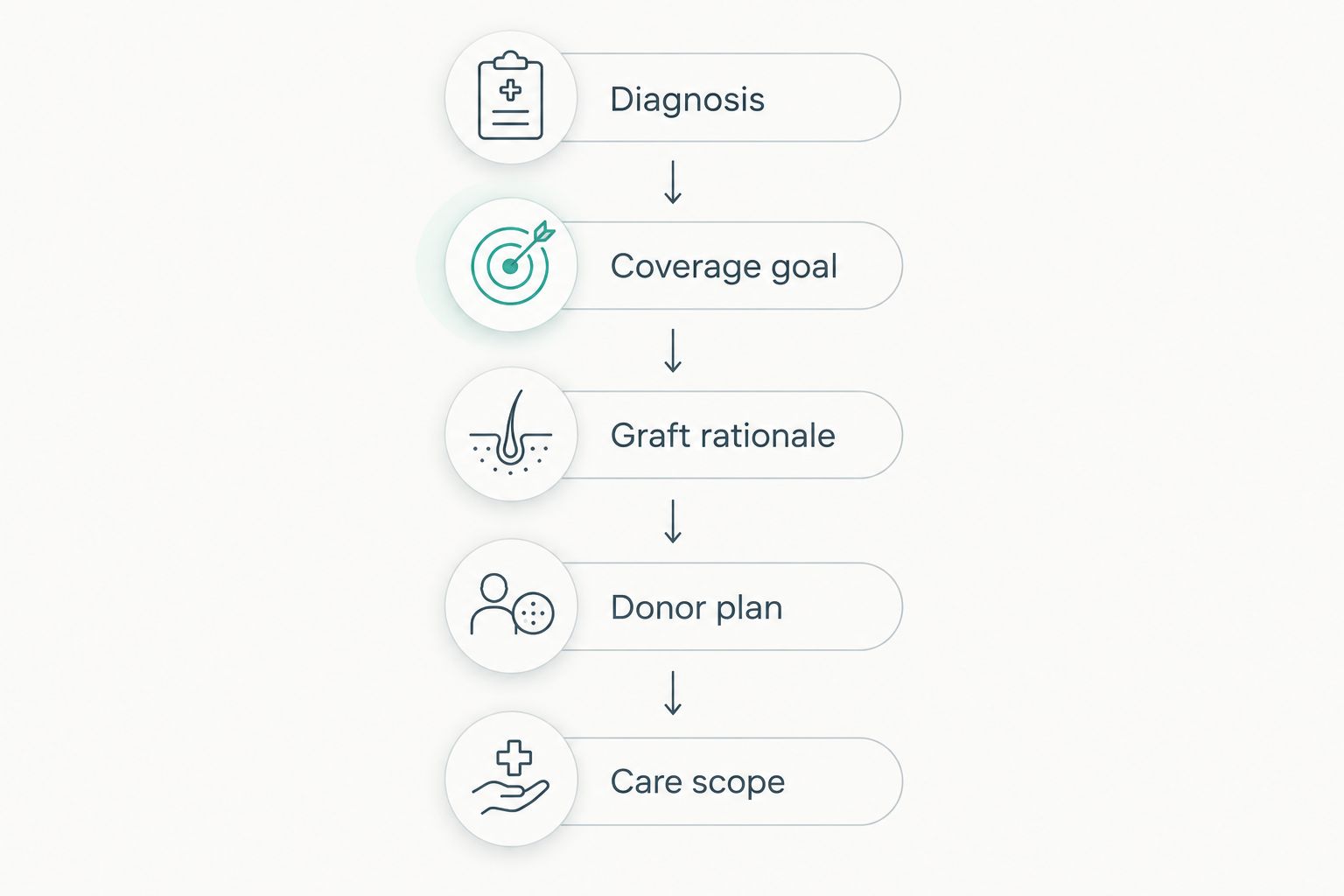
When recommendations differ, ask for the clinical explanation rather than averaging the graft counts. Different assessments require clarification; the midpoint is not automatically the right treatment.
Keep your 2026 proposals dated. If your hair loss, health, or treatment goals change, request reassessment rather than assuming an earlier plan still applies.
Where nonsurgical treatments fit
Nonsurgical treatment addresses a different decision from surgically relocating follicles. It belongs in the assessment when the clinician identifies a suitable medical goal, not simply as an add-on to every transplant proposal.
| Option | Best for | Potential role | Important limitation |
|---|---|---|---|
| Sapphire FUE | Suitable patients seeking surgical redistribution | Moves donor follicles into selected recipient areas | Requires adequate donor capacity and surgery |
| PRP | Patients assessed for a supportive nonsurgical approach | Uses a preparation derived from the patient's blood | Response varies; it does not relocate follicles |
| Stem cell therapy | Patients requesting an evidence and regulatory review | Requires scrutiny of the exact proposed intervention | The label does not establish proven benefit or approval |
Peakhairtransplant lists surgical and nonsurgical treatments. That does not make those treatments equivalent or establish that every patient should combine them.
For PRP, ask what evidence applies to your diagnosis and how response would be assessed. For stem cell therapy, ask exactly what is administered, what regulatory status applies, and what evidence supports the intended use. Do not interpret a treatment being offered as proof that it is appropriate for you.
How these priorities were ranked
Diagnosis comes first because treatment selection depends on the clinical problem. Donor preservation follows because transplantation redistributes a limited resource; hairline design, surgical responsibility, and aftercare then determine how the proposal addresses your goals.
This is an assessment framework, not a clinic performance ranking. Patient photographs and testimonials describe individual experiences; they do not establish your expected outcome or prove that one clinic offers better value.
Which NYC clinic should you choose?
Choose a clinic only after the clinician explains your candidacy, donor limits, proposed hairline, and alternatives in terms you understand. Request clarification when a proposal emphasizes graft volume without explaining the recipient area or future needs.
For an undecided patient, the next move is an individual assessment—not a booking based on a cost ranking. Consider Peakhairtransplant for a Sapphire FUE discussion, while applying the same written-plan checklist to every clinic on your shortlist.
FAQ
What's the best way to compare hair transplant cost in NYC?
Compare written proposals for the same clinical goal after an individual assessment. Check the recipient area, graft rationale, donor plan, surgical responsibilities, and follow-up before judging value.
Which NYC hair transplant clinic is the cheapest?
A defensible lowest-cost comparison requires current, comparable written quotes. Different graft plans and care arrangements make headline offers an unreliable basis for ranking clinics.
Is Sapphire FUE better than standard FUE?
Sapphire FUE is not automatically the better choice for every patient. The recipient-site instrument is one part of treatment; candidacy, planning, graft handling, and clinical execution also matter.
Does a higher graft count mean a better result?
A higher graft count does not automatically mean a better result. The count must fit the recipient area, donor capacity, hair characteristics, and long-term plan.
Can PRP replace a hair transplant?
PRP is not a direct replacement for transplantation because it does not move follicles into a new recipient area. A clinician should explain whether PRP has a suitable role for your diagnosis and goals.
How do I know whether I have enough donor hair?
An individual clinical examination is needed to assess donor capacity. The clinician should consider donor hair characteristics, thinning, previous extraction, and the coverage you want.
Can a clinic guarantee a natural-looking hairline?
A clinic cannot guarantee your individual cosmetic outcome. Ask how the proposed design accounts for your existing hair, facial proportions, donor limits, and possible future loss.
One last thing
Ask the clinician: What would make you recommend against surgery for me? The answer should identify clinical limits, not simply redirect the conversation toward another package.
A clear explanation of what transplantation cannot achieve is useful evidence for your decision. Bring that question to every assessment.